






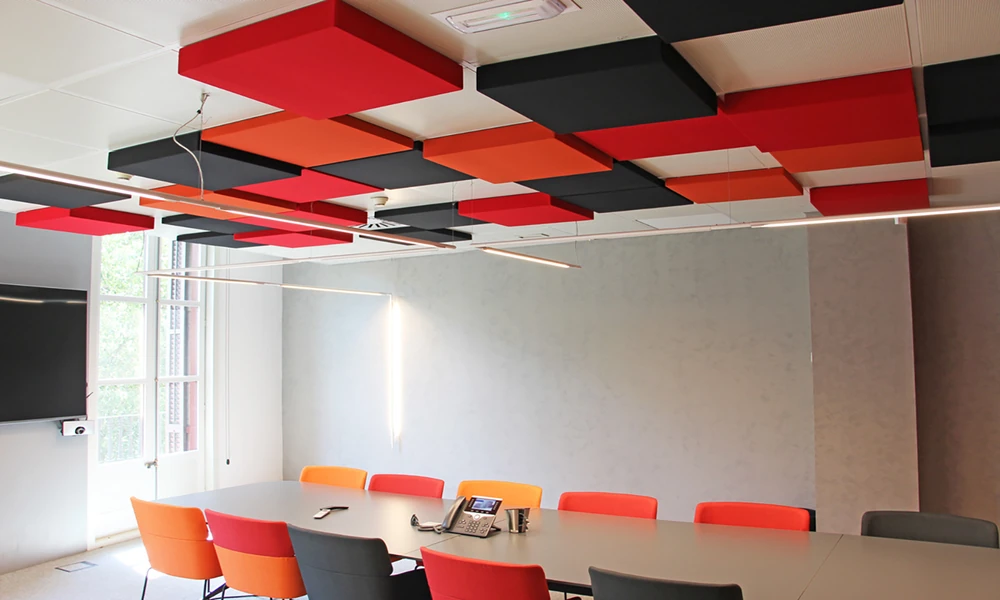
Most people don’t start with the ceiling when thinking about acoustics.
- It usually comes down to what you can’t change.
- Some problems aren’t tied to one spot-they’re everywhere.
- Low ceilings make the ceiling more important than expected.
- Open layouts need something that works across the whole space.
- Sometimes it’s just the least disruptive option.
- When you want improvement without changing the look too much.
- When sound is bouncing between floor and ceiling.
- It also gives you room to scale over time.
- Final Thoughts
Walls feel more obvious. They’re right in front of you, easier to visualise, and seem like the natural place to add treatment.
But once you’re dealing with real, already-built spaces, that mindset tends to shift.
Because in many cases, the question isn’t “what’s ideal?”-it’s “what actually works within the space we already have?”
And that’s exactly where acoustic ceiling panels start to make a lot more sense.
It usually comes down to what you can’t change.
In existing interiors, there are always limitations.
Walls are often:
- Already occupied by furniture or fixtures
- Covered in glass or windows
- Designed in a way that shouldn’t be altered
So even if wall treatment would help, there’s simply no room for it.
Instead of forcing a solution into a tight space, professionals look up.
The ceiling is often the only surface that’s:
- Consistently available
- Less visually sensitive
- Easier to work with without affecting the rest of the layout
At that point, it’s not about preference anymore. It’s about practicality.
Some problems aren’t tied to one spot-they’re everywhere.
There are rooms where you can point to a specific issue, like a reflective wall.
Then there are rooms where the entire space just feels… off.
You might notice:
- Sound lingering longer than it should
- A general “echoey” feel no matter where you stand
- Noise building up across the whole room
In these cases, treating just one area won’t really fix the issue.
Ceiling panels work differently. They don’t target one problem spot-they help reduce sound across the entire space.
Think of it less like a patch and more like a general reset for the room’s acoustics.
Low ceilings make the ceiling more important than expected.
If a room has a low ceiling, sound doesn’t have much room to move. It travels up, hits the ceiling almost immediately, and comes straight back down.
That quick reflection is what creates that slightly “boxed-in” feeling.
You hear it as:
- A tighter, more compressed sound
- Voices bouncing back faster than expected
- A room that feels louder than it should
In this situation, treating the ceiling is actually one of the most direct ways to improve the space. You’re addressing the reflection right where it happens.
Open layouts need something that works across the whole space.
Open-plan spaces come with their own challenges.
- Moves freely
- Spreads across different zones
- Blends everything together
You can treat sections of the space with wall panels, but that often leads to uneven results.
Some areas improve, others still feel noisy. Ceiling panels create a more consistent effect.
They:
- Cover a large surface area
- Distribute absorption more evenly
- Help the entire space feel more controlled
It’s not about isolating zones-it’s about improving the overall environment.
Sometimes it’s just the least disruptive option.
In working environments, disruption matters.
You can’t always:
- Move furniture around
- Block off areas for long periods
- Change how people use the space
Ceiling installations tend to be less intrusive.
Work happens overhead, and the layout below can often stay as it is.
That makes it easier to introduce acoustic improvements without interrupting daily operations.
When you want improvement without changing the look too much.
Some interiors are very design-driven.
Walls might be:
- Carefully finished
- Part of a brand or visual identity
- Meant to stay clean and uninterrupted
Adding wall panels could clash with that.
Ceiling panels, on the other hand, tend to stay out of the main line of sight.
They can:
- Blend into the ceiling
- Follow existing grid systems
- Maintain a clean visual flow
So you’re improving acoustics without changing how the space feels visually.
When sound is bouncing between floor and ceiling.
Not all reflections come from walls.
In some rooms, especially those with hard flooring and minimal furnishings, sound moves vertically.
It goes:
- Up to the ceiling
- Back down to the floor
- And repeats
This creates a kind of “floating” sound effect where noise seems to hang in the air.
Treating walls alone won’t fully solve this.
Ceiling panels break that vertical cycle, which helps reduce overall reverberation in a more noticeable way.
It also gives you room to scale over time.
Another practical advantage is flexibility.
You don’t have to treat the entire ceiling all at once.
You can:
- Start with key areas
- Observe how the space responds
- Add more panels if needed
This makes it easier to manage both cost and adjustments without committing to a full overhaul upfront.
Final Thoughts
Ceiling panels aren’t always the first solution people think of-but in existing interiors, they often end up being the most workable one.
Not because they’re inherently better than wall treatments, but because they:
- Fit within real-world constraints
- Address room-wide acoustic issues
- Allow for minimal disruption
- Maintain the overall design of the space
Once you look at acoustics from that perspective, the ceiling stops being a secondary option.
In many cases, it becomes the most practical place to start.